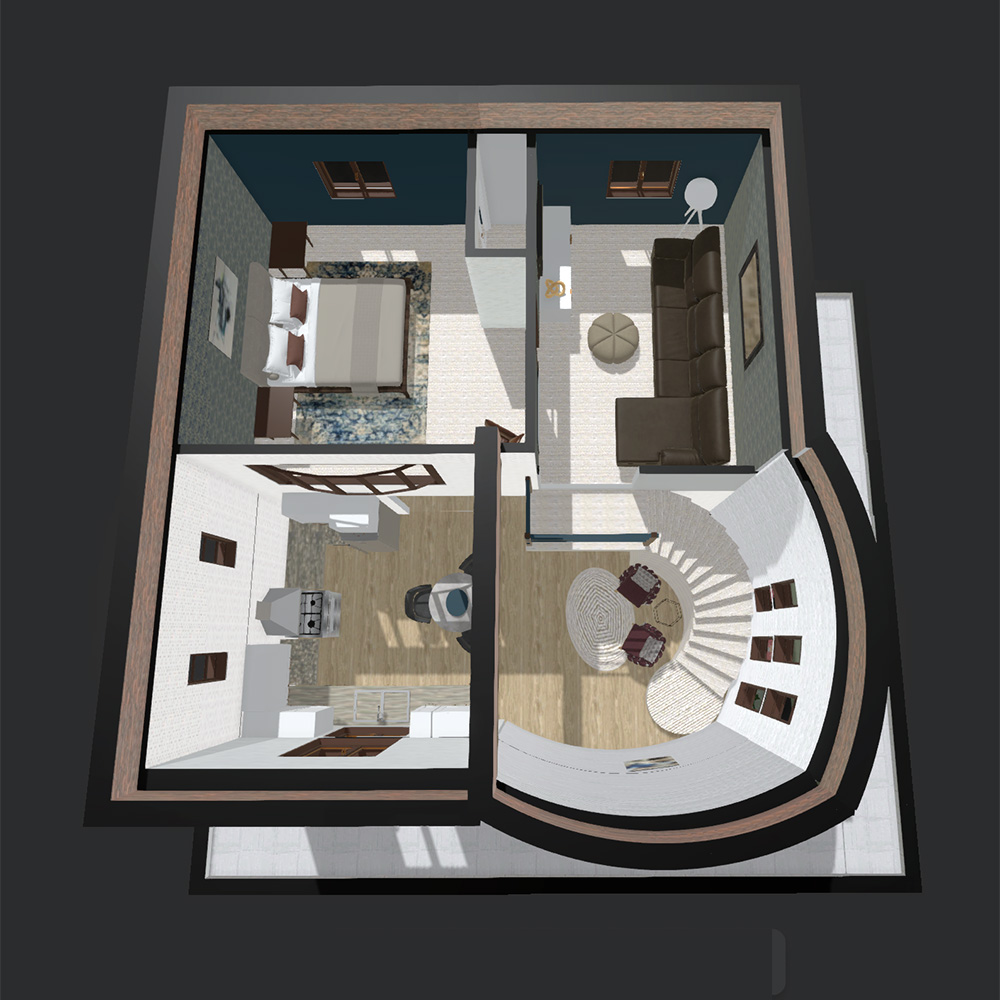
Digital technology has transformed the way we see property.
Real-estate photographs can be enhanced in seconds. Empty rooms can be virtually staged. Artificial intelligence can change lighting, furniture, finishes and even the apparent character of a space.
The results can be extraordinary.
But there is an important distinction between creating an inspiring image and creating useful information.
In a world increasingly flooded with digitally enhanced property imagery, that distinction matters.
Inspiration Isn’t the Same as Reality
Technology can transform an ordinary room into a compelling marketing image. Used responsibly, these tools can help buyers imagine possibilities that might otherwise be difficult to see.
But most digital property imagery stops there.
It captures attention.
It doesn’t necessarily help answer the practical questions people face when buying, selling, furnishing, renovating or maintaining a property.
Will my existing furniture actually fit?
What would this room look like with a different floor?
How much flooring would I need to order?
Could this wall accommodate a larger television?
Where is the furnace filter, and when was it last replaced?
What appliances are installed in the property?
These aren’t questions about creating prettier pictures.
They are questions about making better decisions.
From Property Visualization to Property Utility
Picturethis3D was built around a different idea: create an accurate digital representation of an actual property and make that digital environment useful.
Instead of treating the property as something that exists digitally only while it is being marketed for sale, we see the property as the centre of a much larger ecosystem.
A homeowner should be able to enter their digital property, experiment with furniture, consider renovations, visualize products and make purchasing decisions in the context of the space where those decisions actually matter.
A prospective buyer should be able to do much the same thing before purchasing.
A furniture manufacturer or retailer should be able to show a customer how a real product looks and fits inside that customer’s actual space.
Contractors and service providers should be able to interact with meaningful property information.
And the digital property should remain useful long after the real-estate listing disappears.
Real Property. Real Products. Real Decisions.
That leads to a concept we call Spatial Commerce.
Traditional e-commerce separates the product from the place where it will ultimately be used.
You see a sofa on a white background.
You see flooring in a sample photograph.
You see cabinetry in someone else’s kitchen.
Spatial Commerce changes the context.
Instead of asking consumers to imagine how a product might work in their property, we can increasingly allow them to experience that product inside the property itself.
Real property.
Real products.
Real dimensions.
And ultimately, better-informed decisions.
This becomes particularly important when consumers are watching their spending carefully. A beautiful visualization has value, but helping someone avoid an expensive purchasing mistake has considerably more.
A Property Is More Than a Real-Estate Transaction
There is another limitation in the traditional approach to property technology.
Most real-estate technology revolves around a relatively short event:
the transaction.
A property is listed, marketed, sold and then largely disappears from the technology that helped sell it.
But the property’s useful life continues for decades.
People furnish it.
Renovate it.
Repair it.
Replace appliances.
Paint rooms.
Install flooring.
Upgrade lighting.
Maintain mechanical systems.
Purchase insurance.
Keep warranties and receipts.
Eventually, they may sell it again.
Why should the digital property disappear when the listing does?
We believe it shouldn’t.
From Listing to Digital Property Manual™
An immersive property created for marketing can evolve into something much more valuable after the transaction: a Digital Property Manual™.
Instead of maintaining appliance information in one drawer, renovation records somewhere else, receipts in an email account and maintenance information in someone’s memory, the property itself can become the organizing structure.
Over time, the digital environment can become a persistent record of the property—supporting furnishing, renovation, maintenance and future resale.
The relationship therefore changes from:
List → Market → Sell → Disappear
to:
List → Explore → Buy → Furnish → Renovate → Maintain → Manage → Sell Again
That is a fundamentally different way of thinking about property technology.
One Property Can Connect an Entire Ecosystem
Property touches an enormous number of industries.
Real estate.
Furniture.
Flooring.
Lighting.
Cabinetry.
Appliances.
Construction.
Interior design.
Insurance.
Financial services.
Maintenance.
Home automation.
Building products.
Yet these industries largely operate independently of one another.
An accurate digital property can become the common environment connecting them.
A manufacturer doesn’t simply advertise a product—it can potentially allow the consumer to experience that product in context.
A real-estate professional doesn’t simply show a property—they can provide an environment in which the buyer can begin imagining ownership.
A homeowner doesn’t need another disconnected app—they can build information and decisions around the property itself.
And a digital environment created today can continue creating value tomorrow.
The Next Evolution Is Not Better Imagery
There will always be a place for beautiful property photography, virtual staging and inspirational design.
Picturethis3D uses many of those technologies ourselves.
But we believe the larger opportunity lies beyond the image.
It lies in connecting property information, spatial understanding, products, services and purchasing decisions in a persistent digital environment.
That is the transition from visualization to utility.
From property marketing to property lifecycle.
From looking at products to experiencing them in context.
And from a picture of a property to a digital property manual you will reach for daily.
The future isn’t simply a prettier picture of your property.
It’s a digital version of your property that remains useful for as long as you live in the home.
— Eevi Jensen, Founder & CEO, Picturethis3D